
High-precision 3D scanning technology
Partner Offering in Collaboration with Verus Digital
The three-dimensional capture of cultural heritage today requires the highest geometric precision, exact color reproduction, and reproducible processes. With our high-end 3D digitization services, we provide the foundation for reliable digital reproductions—from individual museum objects to complex collection holdings.
Precision as a Guiding Principle
At the core of our approach is a fully traceable and metrically accurate 3D capture process. The objective is the reliable documentation of geometry, surface characteristics, and color for long-term use in research, conservation, and digital dissemination.
Our workflows support, among others:
- Conservation and restoration documentation
- Scientific analysis and comparative studies
- Digital collection strategies
- High-quality visualization and publication
- Sustainable long-term archiving
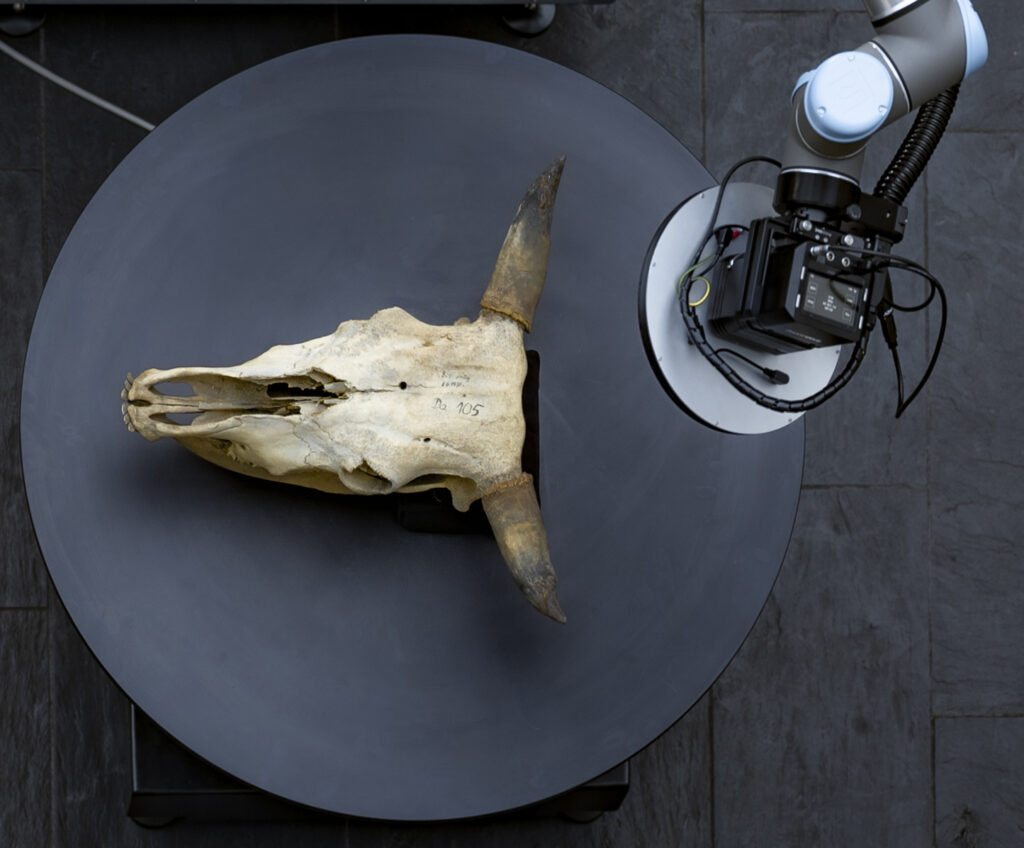
High-End Camera Technology: Phase One IXH
A key quality factor is the imaging technology employed. Our setups utilize the Phase One IXH camera platform, specifically developed for scientific and industrial high-end applications.
IXH technology enables:
- Extremely high resolution for capturing the finest surface details
- Outstanding color fidelity for conservation requirements
- Stable and reproducible acquisition conditions
- Seamless integration into photogrammetric workflows
- Reliable results even with complex materials
This technological foundation ensures that the generated datasets remain scientifically robust and usable in the long term.
Robotics-Assisted Capture Processes
A central element of the workflow is the use of a precisely controlled robotic arm. Robotic movement allows for highly reproducible camera positioning and opens new possibilities for systematic 3D acquisition.
The automated arm provides:
- Precisely defined camera positioning
- Consistent and repeatable motion sequences
- Complex capture paths around the object
- Consistent image overlap for photogrammetry
Robotics reduces manual variability while simultaneously increasing efficiency in large-scale digitization projects. This results in a clear quality advantage, particularly for delicate or complexly shaped objects.
Flexible Application Scenarios
Our service offering is modular and can be adapted to different object classes and project goals. Typical applications include:
- Sculptures and three-dimensional objects
- Archaeological finds
- Museum and collection objects
- Conservation condition documentation
- Digital exhibitions and replication projects
For each project, the capture geometry is individually tailored to the object’s size, material properties, and desired target resolution.
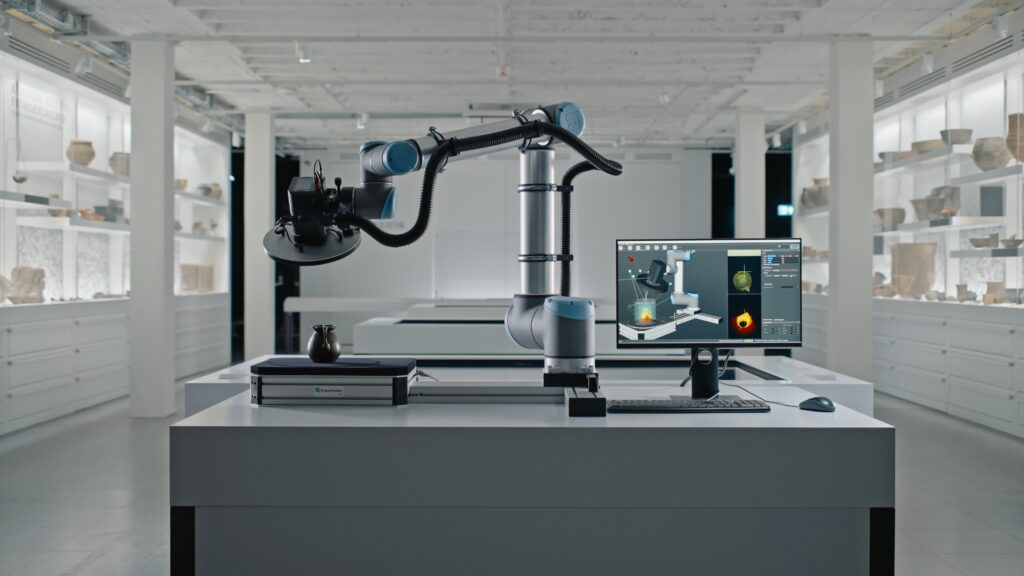
Digitization in the Studio or On Site
Our infrastructure is deliberately designed to be flexible. Digitization can be carried out either in our studio under controlled conditions or directly on site in collections, storage facilities, or exhibitions.
This enables high-quality results even under challenging conditions, such as:
- Site-bound or non-transportable objects
- Large-format or heavy exhibits
- Sensitive collections with restricted handling
- Project-specific environmental requirements
Depending on the situation, we adapt the setup, lighting, robotics, and acquisition parameters individually, ensuring that even complex projects can be realized reliably and efficiently.
From Object to Digital Twin
Image acquisition forms the starting point of a comprehensive workflow. Upon request, we deliver fully processed datasets, including:
- High-resolution textured 3D models
- Metrically evaluable geometric data
- Optimized visualizations
- Project-specific export formats
- Support for integration into existing systems
The result is a precise digital twin that can be sustainably used for research, documentation, and dissemination.